
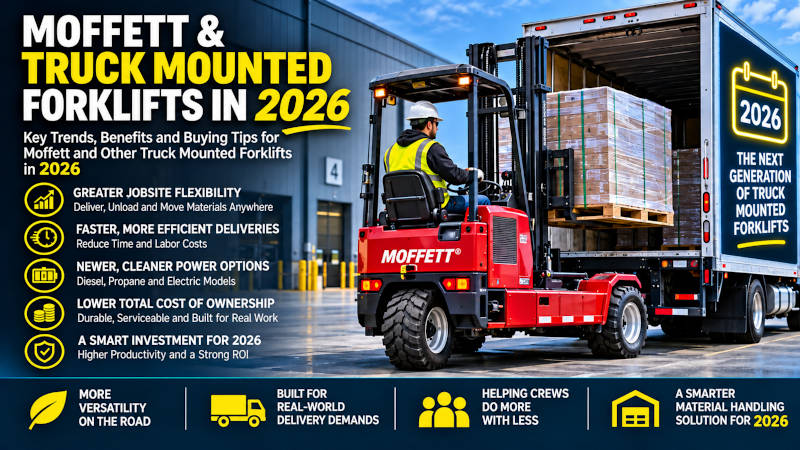
Truck mounted forklifts have become an essential piece of equipment for businesses that deliver heavy materials directly to customers, construction sites, farms, residential properties, and commercial job locations. As companies look for ways to improve delivery efficiency, reduce labor costs, and eliminate unnecessary handling, truck mounted forklifts offer a practical solution that combines transportation and material handling into one operation.
Often called piggyback forklifts, truck-mounted forklifts, rear-mounted forklifts, sod loaders, or truck-carried forklifts, these specialized machines are designed to travel with a delivery truck or trailer and unload materials wherever they are needed.
Unlike conventional forklifts that remain at a warehouse or distribution facility, a truck mounted forklift travels with the load. Upon arrival, the operator removes the forklift from its mounting system and uses it to unload materials without requiring a loading dock, additional forklift, or separate piece of handling equipment at the delivery destination.
In 2026, truck mounted forklifts are serving an increasingly diverse range of industries. Lumber distributors, roofing suppliers, masonry companies, landscape businesses, sod farms, agricultural suppliers, beverage distributors, and construction material dealers all depend on these machines to complete deliveries more efficiently.
Manufacturers are also introducing improvements in operator ergonomics, lifting capacity, maneuverability, reach capabilities, power systems, and mounting configurations.
Whether you're researching a new truck mounted forklift, comparing used piggyback forklifts, or evaluating different manufacturers, understanding the available equipment and its capabilities is essential to making the right investment.
This guide examines the leading truck mounted forklift brands in 2026, popular models, operating advantages, important specifications, and what buyers should consider before purchasing.
What Is a Truck Mounted Forklift?
A truck mounted forklift is a specialized material handling machine designed to be transported on the rear of a delivery truck, flatbed truck, or trailer.
The forklift is secured to a mounting system while traveling. When the delivery vehicle reaches its destination, the operator uses the forklift's mounting equipment to lower the machine to the ground. The forklift can then operate independently to unload the materials.
Most truck mounted forklifts are designed to be removed and ready for operation in approximately one minute, depending on the machine and mounting configuration.
Once unloaded, the forklift can travel across a variety of surfaces, including pavement, gravel, grass, construction sites, and other uneven terrain.
This capability makes truck mounted forklifts particularly valuable for deliveries where conventional warehouse forklifts cannot reach the unloading location.
How Does a Piggyback Forklift Work?
The term piggyback forklift refers to a forklift that rides on the back of a truck or trailer during transportation.
The basic operating process involves four steps:
This arrangement eliminates the need to bring a separate forklift to every delivery location.
For businesses making multiple deliveries throughout the day, the time savings can be substantial.
Why Are They Sometimes Called Sod Loaders?
Truck mounted forklifts are also commonly referred to as sod loaders because the equipment played an important role in transforming the sod delivery industry.
Before piggyback forklifts became widely adopted, delivering large quantities of sod was a labor-intensive process that often required additional equipment and substantial manual handling.
A truck mounted forklift allows a driver to unload pallets of sod at a customer's property, landscaping project, or commercial location without requiring the customer to provide equipment.
Today, the same technology is used across numerous industries, although the term sod loader remains common among landscape suppliers and turf professionals.
The Leading Truck Mounted Forklift Manufacturers and Brands in 2026
Several manufacturers compete in the truck mounted forklift market, offering different capacities, configurations, drive systems, and specialized features.
Although some brands are more widely recognized than others, buyers should evaluate each manufacturer's equipment based on application, availability, service support, and total operating costs.
Here are the major manufacturers and brands buyers should know.
1. MOFFETT – Hiab
MOFFETT is one of the most recognized names in the truck mounted forklift industry.
Manufactured by Hiab, MOFFETT forklifts have established a strong reputation in the material handling and transportation industries. The brand is particularly well known for its compact design, maneuverability, and ability to handle demanding delivery applications.
MOFFETT truck mounted forklifts are used throughout North America and internationally.
Popular MOFFETT model families include:
Model availability and specifications vary by market and configuration.
The M4 series is designed for applications where a lightweight, compact forklift is important. Its low-profile design makes it attractive to businesses looking to maximize the available payload of their delivery vehicles.
The M5 series offers additional lifting capabilities and configurations, including reach and four-way steering options on applicable models.
MOFFETT equipment is used extensively in:
One of the major considerations when purchasing a MOFFETT forklift is the balance between lifting capacity, machine weight, and the payload capacity of the delivery truck.
For companies making frequent deliveries, minimizing the weight of the forklift can help preserve the amount of merchandise that can be transported.
2. PRINCETON PIGGYBACK – Princeton Delivery Systems
Princeton Delivery Systems is another major manufacturer in the truck mounted forklift market.
The company's PIGGY BACK brand has a long history in North American material handling, particularly in the landscape, sod, construction, and building materials industries.
Princeton originally developed equipment for the turf industry before introducing its PIGGY BACK truck mounted forklift concept.
Today, Princeton offers a broad range of machines designed for different delivery requirements.
Popular Princeton models include:
One of Princeton's strengths is its range of available configurations.
Depending on the model, buyers can choose conventional moving mast designs, four-way steering, and extended-reach configurations.
Princeton forklifts are available with lifting capacities ranging from approximately 3,300 to 8,000 pounds across the product family.
Some of the most notable features include:
Four-Way Steering: Allows the forklift to travel sideways, making it easier to maneuver long loads through narrow spaces.
Double-Reach Masts: Allow certain models to unload materials from one side of the truck, reducing the need to reposition the delivery vehicle.
Rough-Terrain Capabilities: Help operators work on construction sites, landscaping projects, and uneven surfaces.
EZ Hitch Mounting System: Princeton's mounting system is designed to simplify mounting and dismounting while incorporating multiple safety connections.
Princeton is particularly popular among companies delivering sod, lumber, roofing materials, brick, block, pavers, and other building products.
3. PALFINGER – Truck Mounted Forklifts
PALFINGER is a major international manufacturer of material handling and lifting equipment.
Its truck mounted forklift lineup offers several configurations designed around different operating requirements.
The current FL product family includes:
PALFINGER offers diesel and electric options, along with different steering and reach configurations.
Its four-way steering systems are particularly useful when handling long materials in confined spaces.
The FLM center-seat design provides an operator position focused on visibility and balanced control.
The FLS features a side-facing operator position designed to improve visibility and operator ergonomics.
The BM remote-controlled configuration provides a different approach to operating a truck mounted forklift, allowing the operator to control the machine remotely.
PALFINGER truck mounted forklifts are suitable for:
PALFINGER is a manufacturer worth considering for businesses looking for modern operator accommodations, specialized reach options, and alternative operating configurations.
Buyers researching older equipment may also encounter the PALFINGER Crayler name in truck mounted forklift listings and international equipment references.
4. LOADMAC – Truck Mounted Forklifts
LOADMAC is a manufacturer specializing in truck mounted forklifts.
The company manufactures its equipment in the United Kingdom and has developed a reputation for compact designs, maneuverability, and specialized reach configurations.
Its equipment is designed for businesses that require efficient unloading capabilities without sacrificing too much delivery vehicle payload.
Popular LOADMAC models and product families include:
Model availability and specifications should be confirmed with the manufacturer or dealer, particularly as the company introduces updated product configurations.
The Ultra series emphasizes compact dimensions and reduced machine weight.
The Super Reach series is designed for applications where operators need additional reach to unload materials from one side of the delivery vehicle.
Depending on configuration, LOADMAC machines can be used in:
For buyers comparing truck mounted forklifts, LOADMAC is a brand worth including in the research process, especially when reach capability and machine weight are important purchasing considerations.
5. DONKEY FORKLIFTS
Donkey Forklifts is an American manufacturer that has developed a range of truck mounted forklifts for material delivery applications.
The company celebrated 40 years of manufacturing in 2026.
Donkey has focused on lightweight equipment, maneuverability, and delivery efficiency.
Its product range includes several specialized configurations.
Popular Donkey models include:
The JACK is a hydrostatic truck mounted forklift with a rated lifting capacity of 5,500 pounds.
The Burro and Burro Volt are smaller truck-carried machines designed for lighter material handling applications.
The Burro Volt is particularly interesting because it introduces an all-electric approach to smaller truck-carried forklift applications.
Donkey also offers different solutions for single-axle and tandem-axle delivery vehicles.
This is an important consideration for businesses looking to reduce truck acquisition costs, improve payload capacity, or simplify delivery operations.
Donkey forklifts are used in applications involving:
For buyers comparing American-made truck mounted forklifts, Donkey deserves consideration alongside the more established manufacturers.
6. NAVIGATOR FORKLIFT
Navigator is another American truck mounted forklift manufacturer.
Built in the United States, Navigator offers machines designed for material delivery, construction applications, and rough-terrain operation.
Its product lineup includes several configurations and lifting capacities.
Popular Navigator models include:
Navigator also offers low-profile configurations, extended-reach options, and different drive arrangements.
The manufacturer emphasizes serviceability, durability, and warranty coverage.
For businesses comparing truck mounted forklift manufacturers, Navigator is another brand worth researching, particularly when considering domestic manufacturing and alternative equipment options.
Comparing Truck Mounted Forklift Brands
When evaluating the leading truck mounted forklift manufacturers, there are several important differences to consider.
| Manufacturer | Brand / Product Family | Notable Features |
| Hiab | MOFFETT | Compact designs, multiple capacities, reach options |
| Princeton Delivery Systems | PIGGY BACK | Broad model selection, TurfMate, four-way steering |
| PALFINGER | FL Series | Center-seat, side-seat, remote-control configurations |
| LOADMAC | Ultra / Super Reach | Lightweight designs and extended reach |
| Donkey Forklifts | JACK, Burro, 4K, 5K | American manufacturing, lightweight delivery solutions |
| Navigator | RT / DT Series | Multiple capacities, rough-terrain configurations |
Not every manufacturer offers the same specifications, dealer coverage, or availability in every market.
The best forklift is not necessarily the one with the highest rated capacity or the most features.
It is the one that best matches your delivery operation.
Understanding Truck Mounted Forklift Capacities
Lifting capacity is one of the most important considerations when purchasing a truck mounted forklift.
Most machines in this category fall within a range of approximately 3,000 to 8,000 pounds, depending on the manufacturer and model.
Common capacity categories include:
3,000-Pound Truck Mounted Forklifts
These smaller machines are suitable for lighter materials, smaller deliveries, and businesses where minimizing forklift weight is important.
4,000-Pound Truck Mounted Forklifts
A popular middle-ground option for businesses handling general building supplies, landscaping products, and agricultural materials.
5,000-Pound Truck Mounted Forklifts
One of the most common capacity categories. These machines offer a balance between lifting capability, machine dimensions, and delivery vehicle compatibility.
5,500-Pound Truck Mounted Forklifts
Designed for businesses handling heavier pallets and materials that require additional lifting capacity.
6,000- to 7,000-Pound Truck Mounted Forklifts
Suitable for heavier construction products, masonry materials, lumber, and demanding delivery applications.
8,000-Pound Truck Mounted Forklifts
These larger machines are designed for businesses that regularly handle substantial loads and need additional lifting capability.
Remember that rated lifting capacity is not the same as the weight of every load the machine can safely handle.
The load center, load dimensions, attachment configuration, and lifting height all affect the actual capacity.
Always consult the manufacturer's capacity chart and data plate before operating a forklift.
Important Features to Consider When Buying a Truck Mounted Forklift
Not all piggyback forklifts are designed the same way.
Two machines with identical rated lifting capacities can have significantly different operating characteristics.
Before purchasing a truck mounted forklift, buyers should evaluate the following features.
1. Two-Wheel Drive vs. Four-Wheel Drive
Drive configuration can make a substantial difference in how a truck mounted forklift performs.
Two-wheel-drive machines may be suitable for paved surfaces, relatively level delivery locations, and applications where extreme traction is not required.
Four-wheel-drive configurations provide additional traction for rough terrain, gravel, grass, construction sites, and other challenging environments.
If your business regularly delivers materials to residential construction projects or undeveloped properties, four-wheel drive may be worth the additional investment.
2. Four-Way Steering
Four-way steering is a valuable feature when transporting long materials.
It allows the forklift to travel forward, backward, and sideways.
This is especially useful when handling:
Instead of making wide turns, the operator can move the forklift sideways through narrow areas.
However, four-way steering is not necessary for every application.
Businesses delivering standard pallets may find conventional steering perfectly adequate.
3. Extended Reach and Double-Reach Masts
Extended-reach forklifts provide additional flexibility when unloading materials from a delivery vehicle.
A reach mechanism allows the forks to extend forward beyond the standard lifting position.
This can be particularly beneficial when unloading materials from one side of a truck without repositioning the vehicle.
Applications include:
Buyers should carefully compare the rated lifting capacity at maximum reach.
A forklift rated for 5,000 pounds at its standard load center may have a lower allowable capacity when the forks are extended.
4. Operator Visibility and Ergonomics
Truck mounted forklift operators frequently mount and dismount their machines throughout the day.
Operator comfort and visibility are important considerations.
Look for:
A machine that is comfortable to operate can help reduce fatigue during demanding delivery schedules.
5. Tire Selection
Tires have a major influence on performance.
Depending on the manufacturer, truck mounted forklifts may be available with different tire configurations designed for paved surfaces, rough terrain, or mixed operating conditions.
Consider where the forklift will spend most of its working hours.
For example, a landscape supplier delivering sod to residential properties may require a very different tire configuration than a beverage distributor working primarily on pavement.
6. Forklift Weight and Truck Payload
One of the most overlooked considerations when buying a truck mounted forklift is its overall weight.
The forklift travels with the delivery vehicle, meaning its weight directly affects the amount of merchandise the truck can legally and safely transport.
A lighter forklift may allow a company to carry more product per delivery.
This can be especially important for businesses operating under strict vehicle weight limitations.
Before purchasing, calculate the combined weight of:
Always verify axle ratings, gross vehicle weight ratings, applicable commercial vehicle requirements, and the manufacturer's mounting specifications.
Diesel, Propane, or Electric Truck Mounted Forklifts?
Power source is becoming an increasingly important purchasing consideration in 2026.
Traditionally, diesel-powered truck mounted forklifts have been popular because of their performance, operating range, and suitability for outdoor applications.
However, manufacturers are expanding their electric offerings and improving alternative power configurations.
Diesel Truck Mounted Forklifts
Diesel remains a common choice for demanding outdoor material handling.
Advantages include:
Diesel machines are particularly attractive to businesses working in construction, agriculture, lumber, and other outdoor industries.
Propane Truck Mounted Forklifts
Propane-powered forklifts are another option, depending on the manufacturer and equipment configuration.
Advantages can include:
Buyers should evaluate fuel consumption, operating costs, local emissions requirements, and manufacturer support.
Electric Truck Mounted Forklifts
Electric truck mounted forklifts represent an important development in material handling.
Battery-powered machines can provide quieter operation and eliminate tailpipe emissions during use.
These advantages may be particularly attractive for urban deliveries, noise-sensitive environments, and businesses pursuing lower-emission operations.
However, electric truck mounted forklifts require careful consideration of:
The availability of electric models varies by manufacturer and product category.
Buyers should not assume that every manufacturer offers a fully electric version of its conventional truck mounted forklift.
The Industries That Depend on Truck Mounted Forklifts
Truck mounted forklifts are used in a surprisingly wide range of industries.
Their ability to transport materials and unload them at virtually any accessible location makes them particularly valuable for businesses that deliver products directly to customers.
Lumber and Building Materials
Lumber distributors are among the largest users of truck mounted forklifts.
Deliveries often include heavy lumber packages, plywood, engineered wood products, and other construction materials.
A piggyback forklift allows the driver to unload materials at residential and commercial construction sites without requiring the customer to have a forklift available.
Four-way steering and extended-reach configurations can be especially useful when handling long materials.
Roofing Materials
Roofing suppliers frequently deliver shingles, insulation, underlayment, and other materials to construction sites.
Truck mounted forklifts allow these materials to be unloaded closer to the installation area.
This can reduce additional handling and improve delivery efficiency.
Sod and Landscape Supplies
Sod delivery is one of the traditional applications for truck mounted forklifts.
Landscape companies and sod farms use these machines to deliver pallets of sod directly to residential properties, commercial landscaping projects, and athletic fields.
The ability to move pallets across grass and uneven terrain makes rough-terrain truck mounted forklifts particularly useful.
Other landscape applications include:
Brick, Block, and Masonry
Masonry suppliers regularly transport heavy pallets of brick, concrete block, and pavers.
Truck mounted forklifts allow drivers to unload these materials at construction locations without requiring additional lifting equipment.
The higher-capacity models can be particularly useful in this industry.
Agricultural Supplies
Agricultural distributors use truck mounted forklifts to deliver:
Many agricultural delivery locations have limited access to conventional loading equipment.
A truck mounted forklift provides the flexibility to unload materials where they are needed.
Beverage Distribution
Beverage distributors can benefit from truck mounted forklifts when delivering large quantities of packaged products to locations without loading docks.
Electric configurations may also be attractive for certain urban and noise-sensitive delivery applications.
Fencing and Outdoor Construction
Fencing contractors and suppliers frequently transport heavy bundles of fencing materials, posts, and related products.
Truck mounted forklifts allow these products to be unloaded directly at residential and commercial projects.
This is another application where specialized lightweight equipment can make a significant difference.
New vs. Used Truck Mounted Forklifts: Which Is the Better Investment?
Purchasing a truck mounted forklift is a significant investment, and buyers should carefully evaluate whether a new or used machine makes the most financial sense.
Both options offer advantages.
Advantages of Buying a New Truck Mounted Forklift
New equipment provides several benefits.
Manufacturer Warranty
New machines generally include manufacturer warranty coverage, providing protection against certain mechanical or manufacturing defects.
Latest Technology
Newer models may include improved operator controls, visibility, ergonomics, power systems, and safety features.
Known Equipment History
Buyers do not have to rely on a previous owner's maintenance records or operating history.
Configuration Options
Purchasing new equipment allows businesses to select the capacity, mast, steering, tires, and other features that best match their application.
Advantages of Buying a Used Truck Mounted Forklift
Used truck mounted forklifts can provide substantial savings compared with purchasing new equipment.
They are particularly attractive to smaller businesses or companies expanding their delivery fleets.
Benefits include:
However, buying used equipment requires careful inspection.
What to Inspect When Buying a Used Piggyback Forklift
Before purchasing a used truck mounted forklift, examine the following components.
Engine and Powertrain
Check for excessive smoke, unusual noises, fluid leaks, and signs of improper maintenance.
Hydraulic System
Inspect hydraulic cylinders, hoses, fittings, and connections for leaks or damage.
Mast and Carriage
Look for worn rollers, damaged mast channels, bent components, and excessive play.
Forks
Inspect the forks for cracks, excessive wear, bending, and other structural damage.
Tires
Check tread condition, sidewall damage, and overall tire wear.
Steering and Drive System
Test steering responsiveness, drive engagement, braking, and overall maneuverability.
Mounting System
Examine the mounting brackets, locking mechanisms, attachment points, and safety connections.
Hour Meter
Compare the displayed hours with available maintenance records and the overall condition of the machine.
Capacity Plate
Verify that the manufacturer's data plate is present, legible, and appropriate for the machine's configuration.
Maintenance Records
Request service records, repair history, and documentation of any major component replacements.
A professional inspection by a qualified technician is recommended before purchasing an expensive used machine.
How Much Does a Truck Mounted Forklift Cost in 2026?
Truck mounted forklift prices vary considerably depending on manufacturer, model, lifting capacity, condition, age, operating hours, and configuration.
There is no single price that applies to every machine.
New equipment generally commands a higher purchase price, particularly when equipped with four-wheel drive, extended reach, specialized mounting systems, and other options.
Used truck mounted forklifts can offer a more affordable alternative.
The following factors have a significant influence on purchase price:
Buyers should compare multiple machines before making a purchase decision.
A lower-priced forklift may ultimately cost more if it requires significant repairs, has limited parts availability, or does not meet the requirements of the delivery operation.
When comparing used truck mounted forklifts, consider the total cost of ownership rather than focusing exclusively on the initial purchase price.
Understanding Mounting Systems and Delivery Truck Compatibility
The mounting system is one of the most important components of a truck mounted forklift.
The machine must be transported securely and remain compatible with the delivery vehicle.
Different manufacturers offer proprietary mounting arrangements and approved installation systems.
Before purchasing, buyers should verify:
Not every forklift will fit every delivery truck.
Even when two machines have similar dimensions, their mounting systems may differ.
Buyers should consult the forklift manufacturer and truck body or chassis supplier before purchasing a machine intended for an existing delivery vehicle.
For businesses purchasing a complete truck and forklift package, it is particularly important to verify that the entire combination is properly configured.
Safety Considerations When Operating Truck Mounted Forklifts
Truck mounted forklifts offer significant productivity advantages, but safe operation must remain a priority.
Operators should receive appropriate training and understand the specific characteristics of the machine they are using.
In the United States, OSHA's powered industrial truck standard, 29 CFR 1910.178, establishes important requirements relating to operator training, equipment condition, maintenance, and safe operation.
Important safety considerations include:
Operator Training
Employees must be trained and evaluated before operating applicable powered industrial trucks.
Daily Inspections
Equipment should be inspected before being placed into service. Defective or unsafe machines should be removed from operation until properly repaired.
Load Capacity
Never exceed the rated capacity of the forklift at the applicable load center and lifting configuration.
Load Stability
Loads should be properly positioned, centered where possible, and secured against movement.
Terrain Conditions
Operators must understand the limitations of the machine when working on slopes, soft ground, uneven surfaces, and other challenging terrain.
Mounting and Dismounting
Follow the manufacturer's procedures when removing and securing the forklift to the delivery vehicle.
Vehicle Stability
The delivery vehicle should be properly secured before unloading, with appropriate attention to parking brakes, wheel chocking where required, and trailer support.
Pedestrian Awareness
Maintain adequate separation from pedestrians, other vehicles, and workers in the unloading area.
Proper operator training and preventive maintenance are essential to protecting employees and maximizing equipment life.
Truck Mounted Forklift Maintenance and Operating Costs
Like any industrial machine, truck mounted forklifts require regular maintenance.
A preventive maintenance program can help reduce unexpected downtime and extend the useful life of the equipment.
Maintenance requirements vary by manufacturer, model, and power source.
Common maintenance items include:
Operators should follow the manufacturer's recommended service intervals.
Maintenance costs should also be considered when comparing different manufacturers.
A machine with a lower purchase price may not necessarily offer the lowest long-term operating cost.
Parts availability, dealer support, service labor, fuel consumption, and machine reliability all influence total ownership expenses.
Truck Mounted Forklifts vs. Conventional Forklifts
One of the biggest advantages of a truck mounted forklift is that it travels with the delivery vehicle.
A conventional warehouse forklift typically remains at a fixed location and requires separate transportation if it needs to be moved to another site.
Truck mounted forklifts solve a different problem.
They are designed specifically for mobile material handling.
| Feature | Truck Mounted Forklift | Conventional Forklift |
| Transportation | Travels on delivery truck or trailer | Typically transported separately |
| Primary Application | Offloading deliveries | Warehouse and general material handling |
| Mobility | Designed for mobile delivery operations | Primarily facility-based |
| Terrain | Models available for rough terrain | Depends on forklift type |
| Mounting | Rear-mounted transport system | Not normally required |
| Delivery Flexibility | Excellent for direct deliveries | Requires equipment at destination |
| Typical Industries | Lumber, roofing, sod, masonry, agriculture | Warehousing, manufacturing, distribution |
For businesses that regularly deliver materials to locations without loading docks, a truck mounted forklift can be a more practical solution than relying on conventional forklifts.
However, companies with primarily indoor warehouse operations may be better served by traditional electric or internal combustion forklifts.
The correct equipment depends on the application.
What to Look for When Buying a Truck Mounted Forklift in 2026
The truck mounted forklift market offers buyers more choices than ever.
However, selecting the right machine requires understanding how it will be used.
Here is a practical checklist for buyers.
Determine Your Required Lifting Capacity
Start by identifying the heaviest pallets or materials your company regularly delivers.
Do not simply purchase the largest forklift available.
Select a machine that provides adequate lifting capacity while maintaining an appropriate balance between forklift weight and delivery vehicle payload.
Evaluate Your Delivery Environment
Will the forklift primarily operate on pavement, gravel, grass, construction sites, or uneven terrain?
Your operating environment should influence your decision regarding drive configuration, tire selection, and ground clearance.
Determine Whether You Need Extended Reach
If your drivers regularly unload materials from one side of a truck, an extended-reach configuration may improve productivity.
If most deliveries involve standard pallet unloading, a conventional mast may be sufficient.
Consider Four-Way Steering
Businesses transporting long lumber packages or other oversized materials should consider four-way steering.
It can make a meaningful difference in restricted delivery areas.
Compare New and Used Equipment
Evaluate both options before making a decision.
A late-model used forklift with low operating hours may offer an excellent balance between price and performance.
Research Parts and Service Availability
Before selecting a manufacturer, determine whether replacement parts, qualified technicians, and service support are available in your operating area.
This is particularly important for businesses that depend on their delivery trucks every day.
Calculate Your Return on Investment
Consider how much time and labor the forklift will save.
A truck mounted forklift may reduce the need for additional personnel, eliminate separate unloading equipment, reduce material handling, and allow more flexible delivery scheduling.
For businesses making numerous deliveries each day, these savings can justify the initial equipment investment.
The Future of Truck Mounted Forklifts: What to Expect Beyond 2026
The truck mounted forklift industry continues to evolve as manufacturers respond to changing customer expectations and transportation requirements.
Several developments are worth watching.
Increased Electrification
Electric power systems are becoming increasingly important throughout the material handling industry.
Truck mounted forklifts are no exception.
As battery technology improves, electric models may become more attractive for companies operating in urban environments and noise-sensitive locations.
Improved Operator Ergonomics
Manufacturers are placing greater emphasis on operator comfort, visibility, accessibility, and safety.
These improvements are particularly important for drivers who operate their machines repeatedly throughout the day.
More Specialized Configurations
Businesses have different delivery requirements.
Manufacturers are responding with specialized configurations, including four-way steering, extended reach, remote operation, and compact low-profile designs.
Lightweight Equipment
Vehicle payload capacity remains an important consideration.
Manufacturers will continue looking for ways to reduce machine weight without compromising structural integrity or lifting performance.
Improved Delivery Productivity
The overall goal remains the same: unload more efficiently, reduce unnecessary handling, and complete more deliveries with fewer resources.
As distribution costs and labor expenses remain important considerations for businesses, truck mounted forklifts will continue to play an important role in material delivery.
Frequently Asked Questions About Truck Mounted Forklifts
What is another name for a truck mounted forklift?
Truck mounted forklifts are also known as piggyback forklifts, rear-mounted forklifts, truck-carried forklifts, sod loaders, and truck-mounted material handling equipment.
What is the most popular truck mounted forklift brand?
MOFFETT and Princeton PIGGY BACK are two of the best-known names in the North American truck mounted forklift market. PALFINGER, LOADMAC, Donkey, and Navigator are additional manufacturers worth considering.
The best brand depends on the application, available specifications, service support, and budget.
How much weight can a truck mounted forklift lift?
Depending on the manufacturer and model, truck mounted forklifts commonly offer rated capacities ranging from approximately 3,000 to 8,000 pounds.
Some specialized configurations may fall outside this range.
Always verify the manufacturer's capacity plate and load chart.
Can truck mounted forklifts operate on grass?
Yes. Many truck mounted forklifts are designed for outdoor operation and can work on grass, gravel, and uneven surfaces.
However, performance depends on the specific machine, tire configuration, ground conditions, load weight, and terrain.
What is a four-way truck mounted forklift?
A four-way truck mounted forklift can travel forward, backward, and sideways.
This feature is especially useful when handling long materials in narrow spaces.
Are electric truck mounted forklifts available?
Yes. Electric truck mounted forklift options are available in certain product categories.
Availability depends on the manufacturer and model.
Buyers should evaluate battery capacity, charging requirements, operating hours, and overall vehicle payload.
Are used MOFFETT forklifts worth buying?
Used MOFFETT forklifts can represent an attractive investment when they have been properly maintained and are in good operating condition.
Buyers should inspect the engine, hydraulics, mast, tires, mounting system, and maintenance history before purchasing.
What is the difference between a MOFFETT and a Princeton forklift?
Both manufacturers produce truck mounted forklifts designed for mobile material handling.
MOFFETT offers several model families with different capacity and reach configurations, while Princeton's PIGGY BACK lineup includes models designed for applications ranging from landscaping and sod delivery to heavier building materials.
Buyers should compare specific models rather than making a decision based exclusively on brand.
Can a truck mounted forklift be installed on any delivery truck?
No. Compatibility depends on the forklift's mounting system, vehicle configuration, frame, weight distribution, axle ratings, and manufacturer requirements.
Always verify compatibility before purchasing or installing a truck mounted forklift.
How long does it take to unload a truck mounted forklift?
Many machines can be dismounted and made ready for operation in approximately one minute.
Actual times depend on the model, mounting arrangement, operator experience, and site conditions.
Where can I buy a used truck mounted forklift?
Used truck mounted forklifts are available through material handling equipment dealers, equipment resellers, auctions, and online equipment marketplaces.
Buyers should compare available machines, specifications, operating hours, condition, and pricing before purchasing.
Find Truck Mounted Forklifts for Sale on Eliftruck.com
Whether you're searching for a new MOFFETT, a used Princeton PIGGY BACK, a PALFINGER truck mounted forklift, or another specialized piggyback machine, finding the right equipment starts with comparing available inventory.
Eliftruck.com connects forklift buyers and sellers through an online material handling equipment marketplace serving the United States, Canada, and Mexico.
With more than 25 years in the material handling industry, Eliftruck.com provides buyers with access to equipment listings across numerous categories and manufacturers.
If you're looking to purchase a truck mounted forklift, compare different models, capacities, configurations, and pricing to identify the machine that best fits your operation.
Businesses looking to sell their existing equipment can also reach buyers actively searching for truck mounted forklifts and other material handling equipment.
Start your search today on Eliftruck.com and find the truck mounted forklift that helps move your business forward.
Final Thoughts
Truck mounted forklifts have fundamentally changed the way many businesses deliver and unload materials.
By combining transportation and unloading capabilities into one piece of equipment, these machines help companies reduce manual handling, improve delivery flexibility, and increase productivity.
In 2026, buyers have several manufacturers to consider, including MOFFETT, Princeton PIGGY BACK, PALFINGER, LOADMAC, Donkey, and Navigator.
Each offers different equipment configurations and capabilities designed to meet specific delivery requirements.
Whether you're purchasing your first piggyback forklift or expanding an established delivery fleet, the most important considerations remain lifting capacity, machine weight, reach, terrain capability, reliability, service support, and overall operating costs.
The right truck mounted forklift is more than another piece of equipment. It is an investment in a more efficient delivery operation.
 Equipment
 Close

Copyright ©2026 Eliftruck.com, Inc.
TEL: +1 (800) 867-3675
FAX: +1 (208) 330-5961
INT’L: +1 (630) 759-4799
