
Introduction
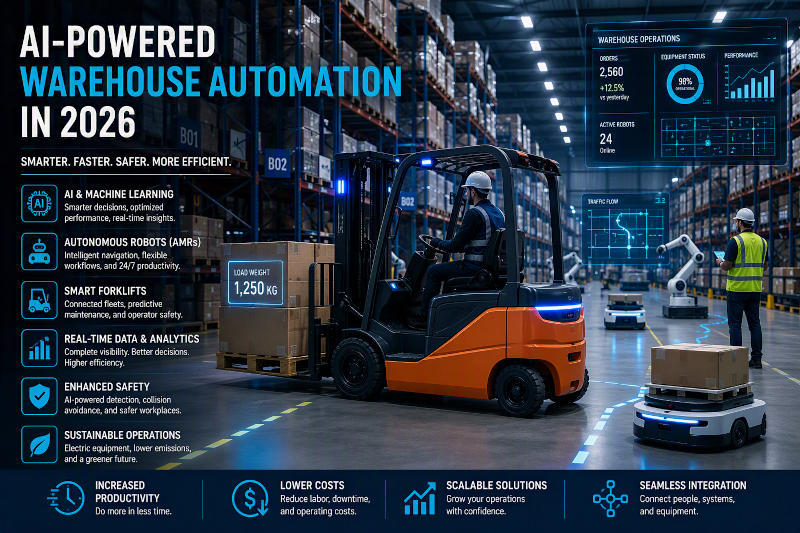
The material handling industry is experiencing one of the most significant transformations in its history. In 2026, artificial intelligence (AI), warehouse automation, autonomous mobile robots (AMRs), smart forklifts, and data-driven logistics systems are rapidly becoming standard operational tools rather than future concepts.
Businesses across warehousing, manufacturing, distribution, e-commerce, construction supply chains, and third-party logistics providers (3PLs) are aggressively investing in automation technologies to address labor shortages, increase throughput, improve workplace safety, and reduce operating costs.
Industry reports show that warehouse automation, AI-driven robotics, AMRs, and software-orchestrated warehouse operations are among the fastest-growing trends impacting material handling in 2026. Companies are increasingly adopting Robotics-as-a-Service (RaaS), intelligent warehouse execution systems, and advanced electric forklift fleets to remain competitive.
For forklift buyers, warehouse managers, and equipment dealers, understanding these trends has become essential when planning future equipment purchases and facility upgrades.
Why Warehouse Automation Is Accelerating in 2026
Several powerful forces are driving automation investments throughout the material handling industry.
Labor Shortages Continue to Impact Warehouses
One of the biggest challenges facing distribution centers is finding and retaining qualified workers. Warehouses continue to struggle with labor availability, rising wages, and employee turnover.
As a result, companies are investing heavily in:
Organizations increasingly view automation as the most reliable solution for maintaining productivity while reducing dependence on labor-intensive processes.
E-Commerce Growth Requires Faster Fulfillment
Consumers expect same-day and next-day delivery.
This demand creates enormous pressure on warehouses to:
AI-enabled warehouse systems can optimize inventory movement and order fulfillment in real time, helping facilities process significantly more orders without expanding labor costs.
What Are Autonomous Mobile Robots (AMRs)?
One of the hottest material handling trends in 2026 is the widespread adoption of Autonomous Mobile Robots.
AMRs are intelligent robotic systems that navigate warehouse floors without fixed paths or guide wires.
Unlike traditional automated guided vehicles (AGVs), modern AMRs use:
These capabilities allow AMRs to transport pallets, inventory, and products throughout warehouses with minimal human intervention.
Benefits of AMRs
Companies deploying AMRs report:
Industry forecasts indicate AMRs will account for a majority of new warehouse automation deployments as adoption continues to accelerate.
Smart Forklifts Are Becoming Data Centers on Wheels
Forklifts remain the backbone of material handling operations.
However, today's forklifts are dramatically different from those sold only a few years ago.
Modern Forklift Technology Includes
These technologies enable warehouse managers to gain unprecedented visibility into fleet operations.
Benefits of Smart Forklift Fleets
Organizations can now:
As digital transformation accelerates, buyers seeking used and new forklifts increasingly prioritize telematics-enabled equipment.
Electric Forklifts Continue to Gain Market Share
Another major trend transforming material handling is the rapid shift toward electric forklifts.
Growing sustainability initiatives, lower maintenance costs, and improved battery technologies are driving adoption across every industry segment.
Advantages of Electric Forklifts
Electric forklifts offer:
Modern lithium-ion battery technology has largely eliminated many concerns regarding charging times and runtime limitations.
The transition away from internal combustion forklifts is expected to continue throughout North America and Europe as companies pursue sustainability goals and operational efficiencies.
AI Is Revolutionizing Inventory Management
Artificial intelligence is improving far more than equipment movement.
AI-powered warehouse software can now:
This intelligence allows businesses to make better inventory decisions while improving customer service levels.
For warehouse operators, accurate inventory forecasting can dramatically reduce storage expenses and increase profitability.
Robotics-as-a-Service (RaaS) Is Expanding Access to Automation
Historically, automation projects required significant capital investments.
Today, that model is changing.
Many providers now offer Robotics-as-a-Service solutions that allow businesses to deploy robotic systems through subscription-based agreements.
Rather than investing millions upfront, companies can:
This model is enabling small and mid-sized operations to compete with larger logistics organizations.
Safety Technology Is Becoming a Competitive Advantage
Warehouse safety remains a top concern throughout the industry.
Advanced safety technologies now include:
Rather than viewing safety as merely a compliance requirement, companies increasingly see workplace safety as a measurable business advantage that reduces accidents, lowers insurance costs, and improves productivity.
Warehouse Software Has Become the Brain of Modern Operations
Many industry experts now describe the modern warehouse as a "software-defined environment."
Warehouse Execution Systems (WES), Warehouse Management Systems (WMS), and AI-driven orchestration platforms are connecting every part of the operation.
These systems coordinate:
Real-time visibility enables managers to make operational decisions based on live data rather than historical reports.
What This Means for Forklift Buyers in 2026
Whether purchasing new forklifts, used forklifts, reach trucks, pallet jacks, order pickers, or warehouse automation solutions, buyers should evaluate equipment through a future-focused lens.
Important considerations include:
Connectivity
Can the equipment integrate with fleet management systems?
Automation Compatibility
Will it work alongside warehouse robots and automation systems?
Telematics
Does it provide performance and utilization data?
Sustainability
Are electric or lithium-ion options available?
Scalability
Can the equipment support future warehouse growth?
Businesses that make technology-focused purchasing decisions today will be significantly better positioned for future expansion.
Why Equipment Marketplaces Are More Important Than Ever
As material handling technology evolves, buyers need access to broader inventories and more equipment choices.
Online equipment marketplaces help buyers compare:
Having access to multiple dealers and equipment brands allows buyers to find solutions that fit both immediate needs and long-term automation strategies.
Conclusion
The biggest material handling trend of September 2026 is clear: warehouses are becoming smarter, more automated, and increasingly driven by artificial intelligence.
AI-powered warehouse management, autonomous mobile robots, electric forklifts, robotics-as-a-service, predictive analytics, and telematics-enabled fleets are fundamentally changing how facilities operate. Industry-wide investment in AI, robotics, warehouse orchestration, AMRs, and software-driven logistics continues to accelerate as companies seek greater efficiency, accuracy, and scalability.
For businesses evaluating forklifts, warehouse equipment, and material handling solutions, understanding these trends is critical for staying competitive in a rapidly evolving marketplace.
Whether you're searching for used forklifts, electric forklifts, warehouse automation systems, pallet handling equipment, reach trucks, or complete material handling solutions, the future belongs to organizations that embrace intelligent technology and data-driven operations.
Ready to compare forklifts, warehouse equipment, and material handling solutions from dealers nationwide? Explore thousands of listings and connect with equipment sellers through Eliftruck.com, Inc., the industry's leading marketplace for forklifts, material handling equipment, and warehouse solutions.
 Equipment
 Close
Close

Copyright ©2026 Eliftruck.com, Inc.
TEL: +1 (800) 867-3675
FAX: +1 (208) 330-5961
INT’L: +1 (630) 759-4799
